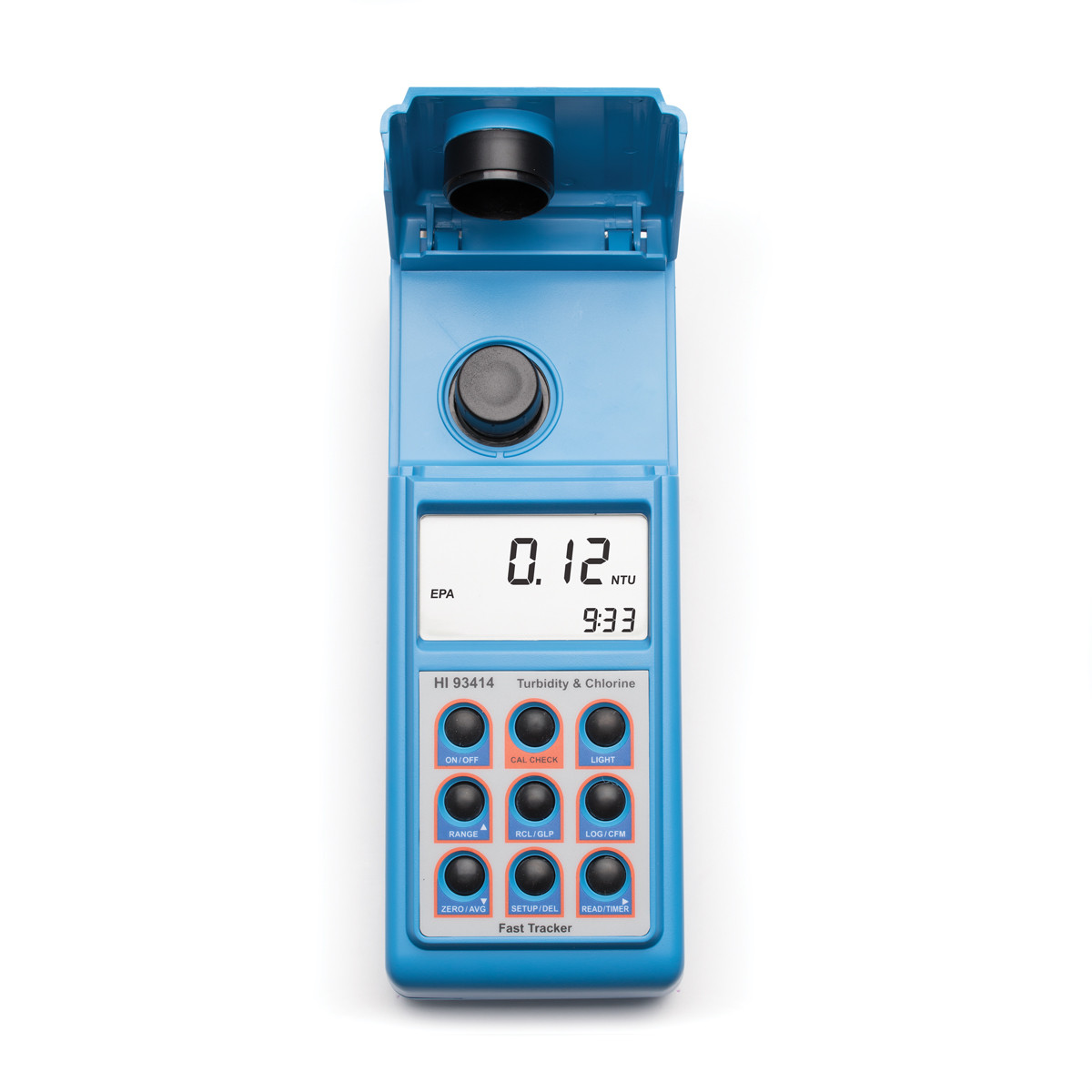
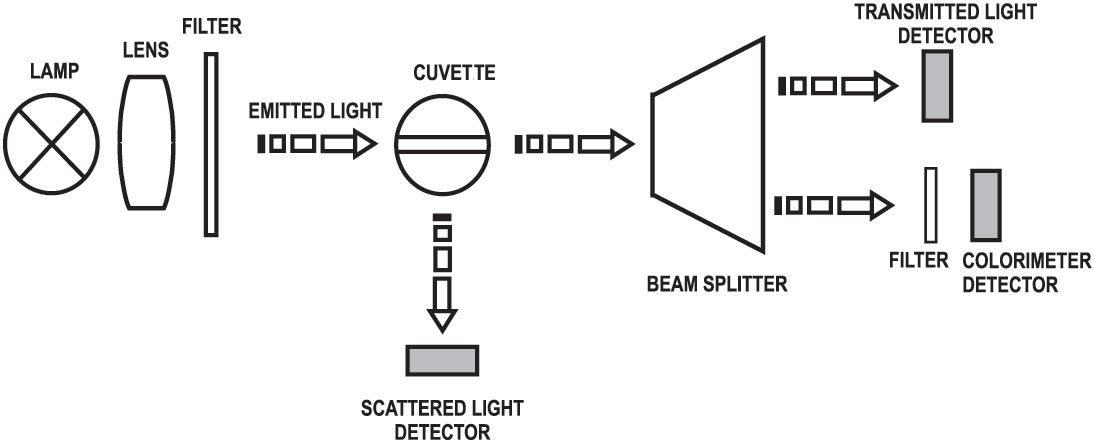
Our Turbidity and Chlorine Portable Meter (HI93414) is a multiparameter instrument that measures the most important parameters in drinking water: turbidity and chlorine. The instrument is based on a state-of-the-art optical system which provides accurate results by minimizing stray light and color interferences. Periodic calibration with the supplied standards compensates for any variations in intensity of the tungsten lamp. The colorimeter portion of the meter uses a 525 nm narrow band interference filter for maintaining the proper wavelength in the measurement of free and total chlorine. All measurements are performed with 25 mm round cuvettes composed of special optical glass to ensure maximum repeatability of turbidity and chlorine measurements.
Features at-a-glance:
- Three Measurement Modes - The HI93414 features three options for measurement including ratio mode for turbidity, free chlorine, and total chlorine. Turbidity measurements can be made in the 0.00 to 1000 NTU (Nephelometric Turbidity Units) range, while free or total chlorine measurements can be made in the 0.00 to 5.00 mg/L (ppm) range.
- Multiple reading modes - Normal measurement, continuous measurement, or signal averaging measurement are reading modes available
- EPA Compliant - The HI93414 meets and exceeds the requirements of EPA and Standard Methods both for turbidity and colorimetric chlorine measurements. When the meter is in EPA mode all turbidity readings are rounded accordingly to meet reporting requirements.
- Calibration - A two, three, or four-point turbidity calibration can be performed by using the supplied (<0.10, 15.0, 100, and 750 NTU) standards. Calibration points can be modified if user-prepared standards are used. For free and total chlorine, the 1.00 mg/L (ppm) CAL Check™ standard can be used for calibration and performance verification.
- AMCO AEPA-1 Primary Turbidity Standard - The AMCO AEPA-1 supplied standards are recognized as a primary standard by the USEPA. These non-toxic standards are made of styrene divinylbenzene polymer spheres that are uniform in size and density. The standards are reusable and stable with a long shelf life.
- CAL Check™ – With the powerful CAL Check™ function, reliable performance of the chlorine colorimeter can be validated at any moment by using the exclusive Hanna ready-made, NIST traceable standards. All standards are supplied with a Certificate of Analysis (COA) for traceability.
- Fast Tracker™ - For advanced field applications, the HI93414 is equipped with Fast Tracker™ - Tag Identification System (T.I.S.) that makes data collecting and management simpler than ever. Fast Tracker™ allows users to record the time and location of a specific measurement or series of measurements using iButton® tags near sampling points for quick and easy readings. Each iButton® tag contains a computer chip with a unique identication code encased in stainless steel.
- GLP Data – The HI93414 features complete GLP (Good Laboratory Practice) functions that allow traceability of the calibration conditions. Data includes calibration points, date, and time.
- Data Logging – Up to 200 measurements can be stored in the internal memory and recalled at any time.
- Data Transfer – For further storage or analysis options, logged data can be downloaded to a Windows compatible PC using the RS232 or USB ports and the HI92000 software.
- Backlit Display – A backlit LCD display provides an easy to understand, user-friendly interface. Displayed codes guide the user step-by-step through routine operation and calibration.
Turbidity is one of the most important parameters used to determine the quality of drinking water. Once considered as a mostly aesthetic characteristic of drinking water, significant evidence exists that controlling turbidity is a competent safeguard against pathogens. In natural water, turbidity measurements are taken to gauge general water quality and its compatibility in applications involving aquatic organisms. The monitoring and treatment or wastewater was once solely based on the control of turbidity. Currently, the measurement of turbidity at the end of the wastewater treatment process is necessary to verify that the values are within regulatory standards.
Turbidity of water is an optical property that causes light to be scattered and absorbed, rather than transmitted. The scattering of light that passes through a liquid is primarily caused by the suspended solids present. The higher the turbidity, the greater the amount of scattered light. Even a very pure liquid will scatter light to a certain degree, as no solution will have zero turbidity.
Drinking water treatment plants that obtain water from surface water are required by the EPA to monitor and report the turbidity. Surface water sources include lakes and rivers. The requirements of the nephelometer and reporting measurements according to EPA Method 180.1 are:
- The applicable range is 0-40 nephelometric turbidity units (NTU)
- Light source: Tungsten lamp operated at a color temperature between 2200-3000°K.
- Distance traversed by incident light and scattered light within the sample tube: Total not to exceed 10 cm.
- Detector: Centered at 90° to the incident light path and not to exceed ±30° from 90°. The detector, and filter system if used, shall have a spectral peak response between 400 nm and 600 nm
- The sensitivity of the instrument should permit detection of a turbidity difference of 0.02 NTU or less in waters having turbidities less than 1 unit.
Report results as follows:
| NTU reading |
Rounded to nearest |
| 0.0 - 1.0 |
0.05 |
| 1 - 10 |
0.1 |
| 10 - 40 |
1 |
| 40 - 100 |
5 |
| 100 - 400 |
10 |
| 400 - 1000 |
50 |
| > 1000 |
100 |
The HI93414 meets and exceeds the meter criteria specified by the EPA Method 180.1 and Standard Methods for the Examination of Water and Wastewater 2130 B.