
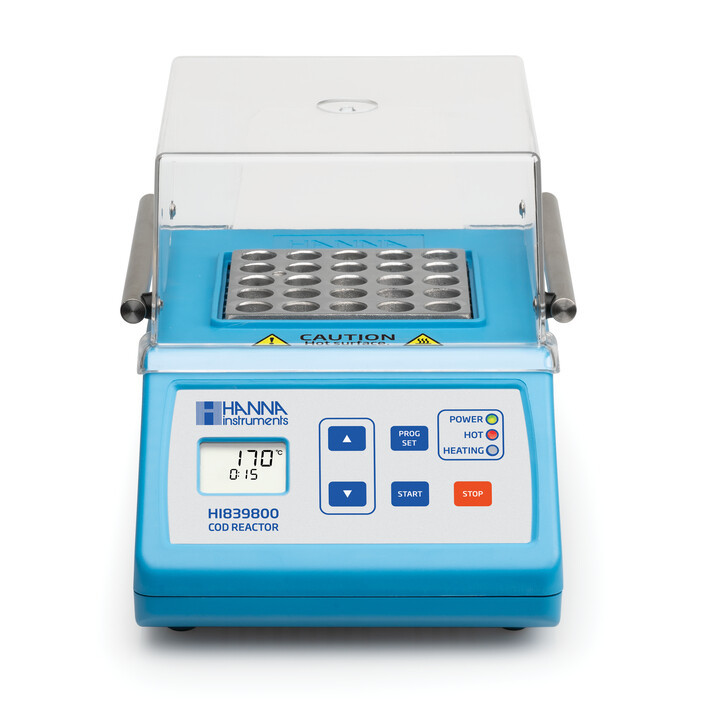


COD Reactor
Features at-a-glance:
Included Laboratory Safety Shield
Equipped with weighted handles that maintain the proper safety position throughout the digestion procedure. Use of a safety shield is strongly recommended to ensure a safe working environment.
Built-in Countdown Timer
A timer of up to 180 minutes is included for applications that require timed digestions. Once a digestion time has ended, 5 audible short beeps will sound, and the "DONE" message will display. As a result, the heat will turn off, and the block will begin to cool off.
Status Indicator Lights
Includes three LED lights. A POWER (green) light means that the reactor is turned on. A HEATING (yellow) light that is continuous indicates that heating is in progress whereas a blinking yellow light means that the block is maintaining a stable temperature. A HOT (red) light indicates that the reactor block temperature has risen above 50 °C (122 °F) and this is also a reminder for users that the aluminum element is hot.
Overheating Prevention
Our reactor contains a thermal fuse that prevents overheating. Should overheating occur, the heater automatically shuts down, and all LED indicator lights will turn off.
Reference Temperature Probe Well
A small temperature well can accommodate a temperature probe which is useful for verifying the heating block.
Warnings and Error Messages
Display messages will appear when erroneous conditions occur and when values are outside of the expected range such as a high or low temperature, hot surface, or heating system malfunction.


